Personal finance app
An offline Android app that organizes a family's finances from bank statements, with rules that learn from every correction.
Context
My household finances lived in a spreadsheet: each person's cards, fixed bills, installments tracked by hand, a grocery budget and a monthly savings goal. It worked, but it took effort, and the most important question ("how much is left this month?") meant doing math in my head.
I wanted to turn that spreadsheet into an app that worked offline, with no login, and with as little effort as possible: import the bank statement and let the app recognize almost everything on its own.
Solution
Before writing code, I did a domain analysis based on the spreadsheet and a FigJam board: entities, rules, states and open questions. With that settled, I built the app:
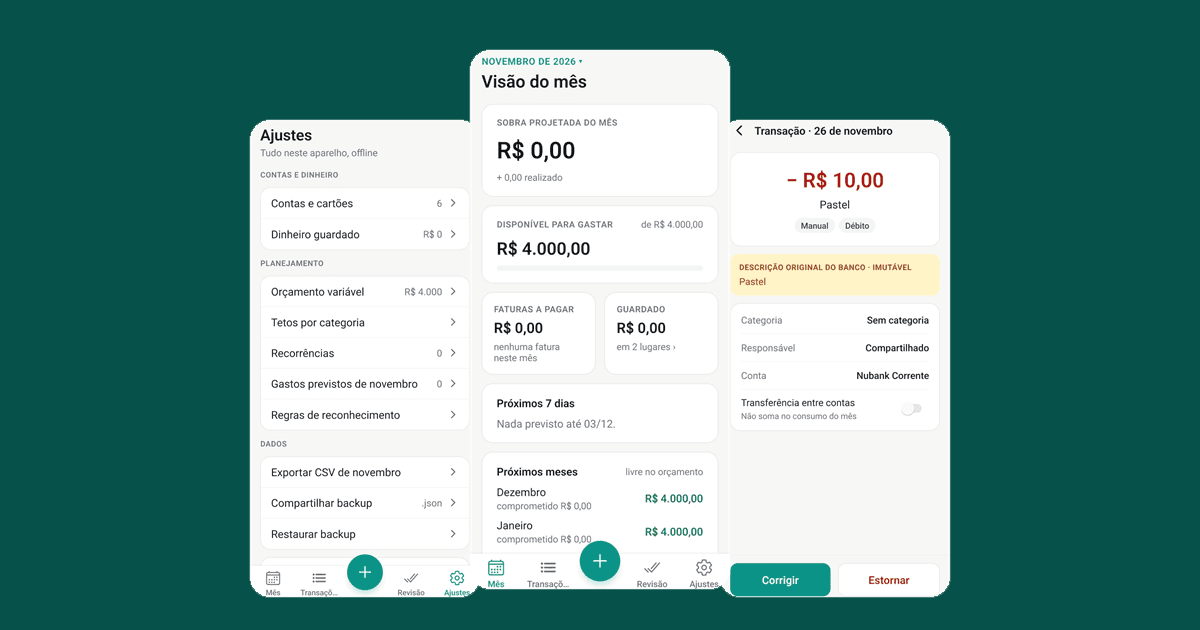
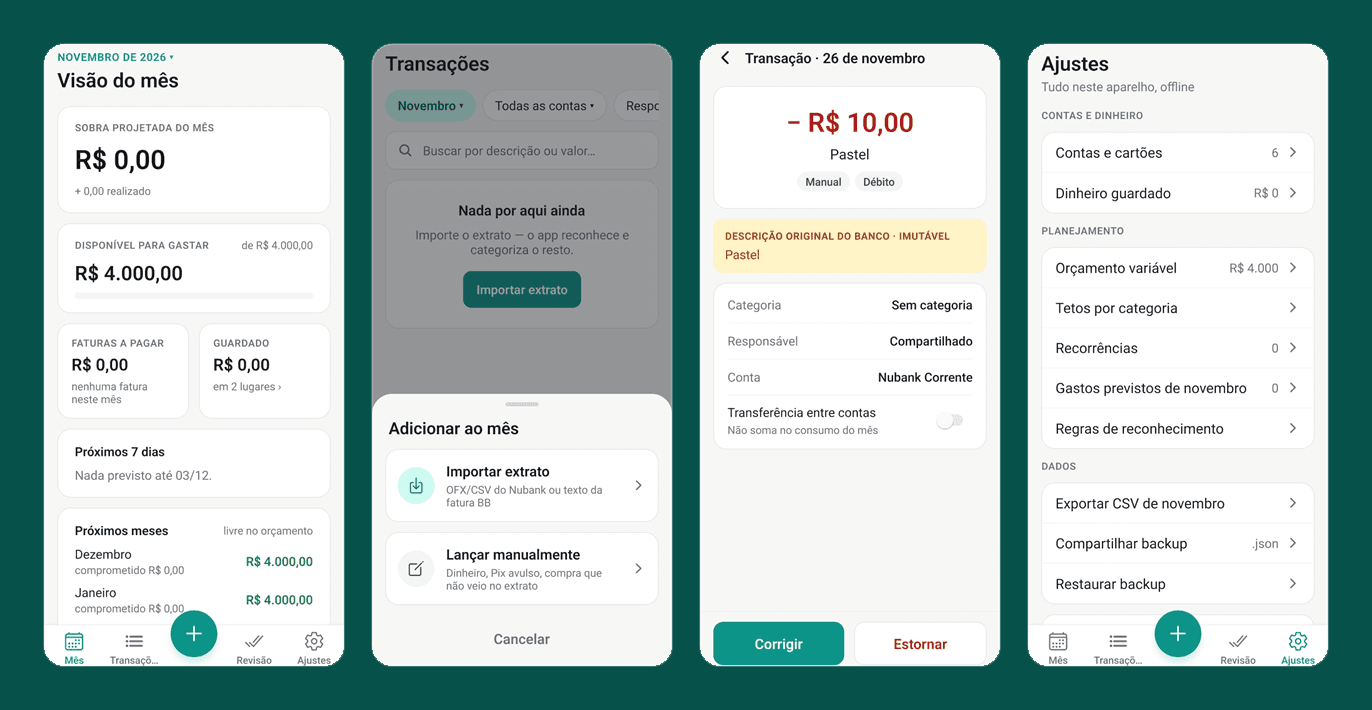
- Month overview, with projected leftover, what is still available to spend, card bills due and the coming months.
- Statement import from Nubank (OFX and CSV) and from Banco do Brasil card bills (pasted text), in three steps.
- Recognition rules that turn the bank's description ("COMPRA CARTAO XV DE NOVEMBRO") into the name the family uses ("Groceries"), with category and owner.
- A review queue with only what the rules did not recognize. When you correct a transaction, the app offers to create a rule for next time.
- Planning with a variable budget, category caps, recurring items, expected expenses and savings.
- Credit cards with billing cycles: the closing day decides which bill each purchase lands on.
- JSON backup and monthly CSV export.
How it works
- Three layers of information. The bank's original description is immutable. On top of it sit what the rules inferred and what the person corrected. Rules can be audited and redone without losing the original data.
- Imports without duplicates. Each imported entry gets a sha256 key built from its data. Importing the same statement again, or one that overlaps the last, creates nothing twice.
- A pure domain. Calculations, billing periods, installments, recurring items and rules live in a layer with no React Native, and a test makes sure it stays that way.
- Local data. SQLite on the device with Drizzle ORM and versioned migrations. Amounts are stored in integer cents, so there are no rounding errors.
Result
The app reached a working version on Android, with 287 automated tests covering the domain, statement parsing and the database.
I never ended up using it day to day. As the analysis went deeper, the business rules (installments, card bills, transfers between accounts, owners) grew beyond what a personal project justified. It became the project where I practiced domain modeling the most: understanding a real process, turning it into clear rules and testing each one.
Stack
- React Native
- Expo
- TypeScript
- SQLite
- Drizzle ORM
- Vitest